

A multi-stop business day in Dubai runs well when the stops are grouped by district, each leg has a buffer for travel, arrival, and overrun, and the chauffeur has the full plan the day before. Three or more appointments in one day is the point where one car and one driver on an hourly or full-day booking starts to beat booking each trip separately. The schedule should be built around buffers first and appointments second, because one late meeting is what breaks most itineraries.
Most executives do not struggle with the meetings. They struggle with the gaps between them. A calendar that looks tidy on screen can fall apart by the third stop when a meeting runs long and the next venue is across the city. This guide is about the logistics: how to build the day, what to tell the driver, and what to do when the plan slips. If you are booking a corporate chauffeur for a visiting team or for yourself, this is the planning side that decides whether the day feels calm or rushed.
Where Multi-Stop Days Usually Go Wrong
Before building a schedule, it helps to know what tends to break one. The same few mistakes show up again and again.
- Appointments are placed back to back with no allowance for travel, parking, security, or the walk to a meeting room.
- Stops are sequenced by the order the meetings were confirmed, not by where they are, so the car crosses the city twice.
- Addresses are given as a building name only, and the driver arrives at the wrong entrance or the wrong tower.
- One meeting runs over, and nobody has decided in advance what gets shortened or moved.
- The first stop is placed in peak traffic and sets the whole day behind.
Build the Day Around Buffers, Not Appointments
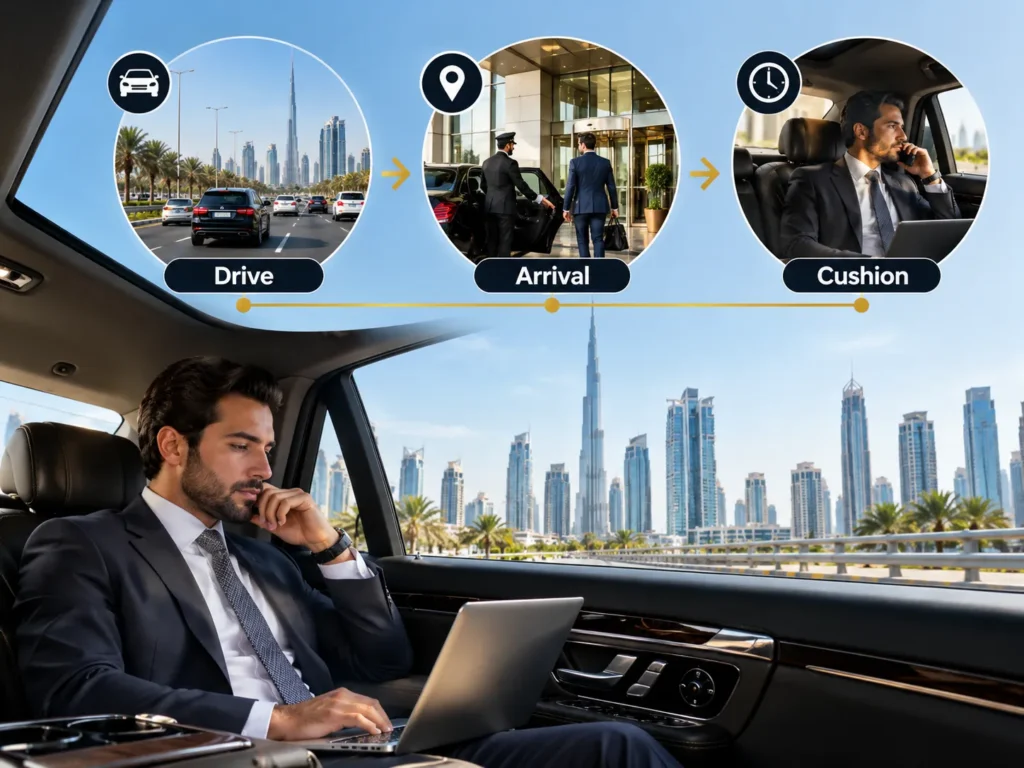
The simplest fix is to plan each leg as three parts rather than one. A leg is the drive, the arrival, and a cushion.
- Drive: the realistic travel time at that hour, not the best case on a map.
- Arrival: time to reach the door, clear building security or visitor registration, and get to the right floor.
- Cushion: a margin for the previous meeting running over or a slow road.
Adding these up for every leg is what turns a tight diary into a workable one. A common mistake is to treat the cushion as wasted time. It is closer to insurance. When nothing goes wrong, it becomes a few quiet minutes to read notes or take a call in the car.
A rough rule many assistants use is to allow more cushion before the meetings that matter most, such as the investor meeting or the client signing, and less before a casual coffee.
Group Stops by District Before You Set Times
Dubai is long and thin, and the main business districts sit along a single corridor with a few spurs. Grouping stops by area cuts the number of long cross-city legs. This table is a planning aid, not a timetable.
| Cluster | Typical stops | Planning note |
|---|---|---|
| DIFC and Downtown | Law, finance, client lunches | Drop-off bays get busy around lunch and early evening |
| Business Bay | Offices, hotels, serviced suites | Close to DIFC and Downtown, but heavy at the start and end of the working day |
| Sheikh Zayed Road corridor | Towers and hotels along the main artery | Slows noticeably at peak, so avoid placing a tight meeting right after |
| Dubai Internet City, Media City, Marina, JLT | Tech, media and west-side offices | Treat as its own block rather than a quick hop from DIFC |
| Airport, Deira, Garhoud | Arrivals, departures, east-side offices | Allow extra time, especially for departures |
If two meetings are in the same cluster, put them next to each other in the day. If one is far from the rest, give it the first or last slot so it does not split the day in half.
A Worked Example: Six Stops in One Tuesday
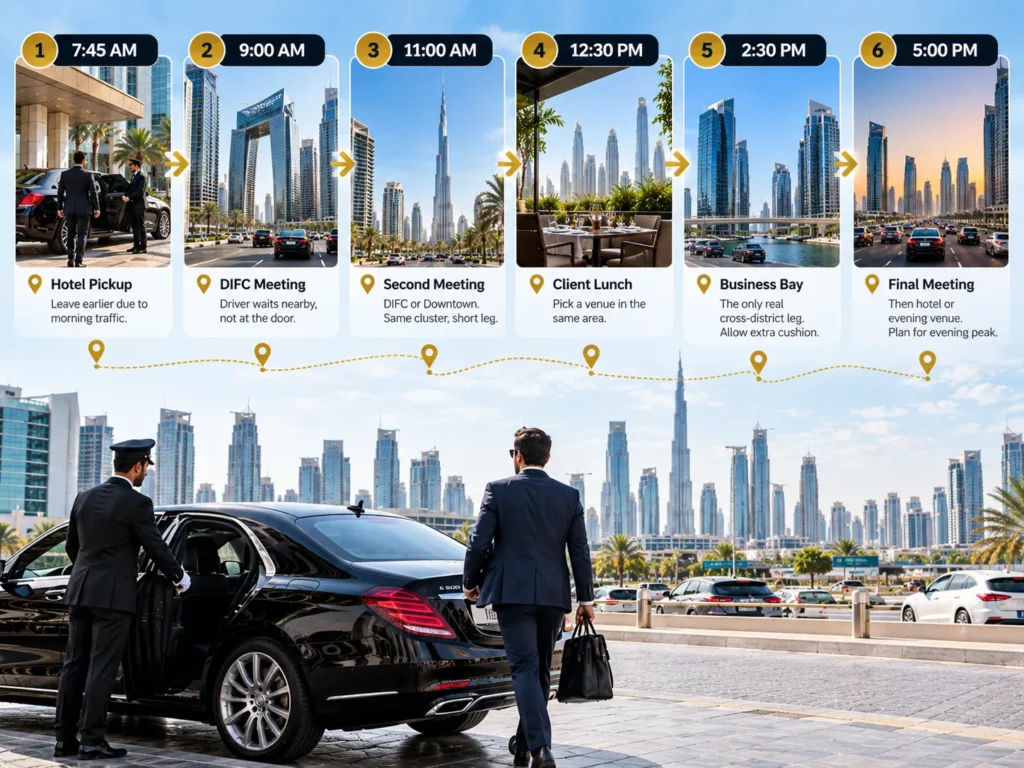
Numbers help here, so here is a sample day for a visiting executive staying on the Marina side. The times are illustrative, and the point is the shape.
- 7:45 am: Hotel pickup. Leave earlier than the first meeting suggests, because this is the leg through morning traffic.
- 9:00 am: Meeting in DIFC. The driver waits nearby, not at the door.
- 11:00 am: Move to a second DIFC or Downtown meeting. Same cluster, short leg, no stress.
- 12:30 pm: Client lunch. Pick a venue in the same area as the morning meetings, not across the city.
- 2:30 pm: Business Bay meeting. This is the only real cross-district leg of the day, so it gets the biggest cushion.
- 5:00 pm: Final meeting, then hotel or an evening venue. Allow for the evening peak on the way back.
A plan like this has five movements but only two long ones. Reorder the same meetings by confirmation time instead of location, and it can easily turn into four long legs.
Timing Rules Specific to the UAE
Some calendar points are local, and they catch visitors out.

Fridays
Friday prayers are held around 1:15 pm across the UAE, and many offices slow down or close for part of the early afternoon. Scheduling an important meeting right across that window is a common reason for delay.
Ramadan
Working hours shorten during Ramadan, and the daily rhythm shifts. Meetings tend to move earlier in the day, and evening traffic patterns around iftar differ from the rest of the year. Confirm timings directly instead of assuming your usual pattern.
Peak Hours
Morning and early evening rush hours add real time to any leg through the main corridor. Keep the first and last legs of the day, and any leg that crosses districts, away from those windows where you can.
What to Give the Chauffeur the Day Before
A driver can only manage a plan they have seen. A short written brief removes most of the problems before they start.
- The full list of stops in order, with the exact building and entrance, not just the area.
- A contact number for each venue and for the person meeting you there.
- The names of any guests being collected, and how many people will be in the car at each stage.
- Which meetings are fixed and which can move, so the driver knows where there is room.
- Any items in the car, such as documents or samples, and how they should be handled.
- Whether calls will happen in the vehicle, so the driver keeps conversation out of the way.
A familiar dedicated driver across several days makes this easier, because the same person already knows your habits and the building entrances you use.
Handling Overruns and Cancellations on the Day
Every itinerary meets a delay at some point. What matters is having a rule before it happens.
- Agree in advance which stop is the one that cannot move, and which can be shortened.
- Ask the driver to message the next venue as soon as a meeting runs over, so they are not left waiting without notice.
- If a meeting is cancelled, ask whether the freed time is better spent as a break, a call in the car, or an earlier start at the next stop.
- If the whole day slips by more than an hour, decide early whether to drop the last stop rather than rushing every remaining one.
The driver can only adjust if you say so quickly, which is why a short message beats waiting until the next stop to explain.
It also helps to keep one person responsible for changes. If an executive, an assistant and a colleague all message the driver with different instructions, the day gets confusing fast. Naming a single contact for the day, usually the assistant, keeps the plan consistent and gives the driver one voice to follow.
A short note at the end of the day is worth the effort too. If a stop kept running late or a venue entrance caused delays, write it down. The next itinerary can then be built with that knowledge, and repeat visits to the same buildings get smoother each time.
Using the Car as a Working Space
Between stops, the vehicle is often the only quiet room an executive has all day. A few habits make it more useful.
- Take calls in the back seat. A trained driver keeps conversation to a minimum and does not repeat what they hear.
- Keep a charger and a notepad in reach, and ask the driver to confirm they are in the vehicle before the day starts.
- Do not leave sensitive documents unattended, and agree where they go when you are in a meeting.
- Use the cushion time to read notes for the next stop rather than answering email in a rush at the door.
This is part of what a trained driver brings to the day, and it is covered in more detail in what a chauffeur does from one trip to the next.
Choosing the Booking Format for a Multi-Stop Day
The booking type should match the shape of the day, not the other way round.
- Short schedule, two or three stops: an hourly chauffeur booking with a clear end time.
- Busy single day, four or more stops: a full-day booking, so the same car stays with you from morning to evening.
- Recurring weekly pattern: a monthly chauffeur arrangement can work out more sensibly than booking each day separately.
- One-off hop plus a long wait: a point to point transfer, as long as you do not need the car in between.
How these options are priced, and what changes the number, is laid out in chauffeur pricing factors.
When the Itinerary Leaves Dubai or Starts at the Airport
Some business days stretch beyond the city. Two situations come up often enough to plan for.

Starting With an Airport Arrival
A morning flight into a meeting day adds a fixed point at the start. Flight delays push everything after it, so keep the first meeting loose and book an airport pickup that tracks the flight. Knowing which terminal and airport you are using helps, and DXB or DWC explains the difference.
Adding an Abu Dhabi or Intercity Leg
A single day with meetings in two emirates is possible, but the travel itself is a block of the day. The drive and its timing are covered in Dubai to Abu Dhabi, and a planned intercity transfer is usually better than treating it as just another stop.
When One Car Is Not Enough
A single executive travelling alone is the easy case. Groups change the plan.
- A delegation of more than three or four people usually needs a larger vehicle or a second car.
- If two people have different schedules, two vehicles may cost less in lost time than one car shuttling between them.
- Seniority matters for seating and arrival order, so settle it in advance.
- Review the vehicle options early, since larger vehicles are fewer in any fleet.
Planning Questions Worth Settling Early
How many stops justify a chauffeur for the whole day?
Three or more appointments spread across different districts is the usual tipping point, because separate bookings add waiting and rebooking time at each stop.
Should the driver wait at the door or nearby?
Nearby is usual, since many towers have limited drop-off bays. Agree a pickup spot and a way to call the driver when you are ready.
Can the plan change during the day?
Yes, within the booked hours. A dedicated driver can reorder or drop a stop, as long as you tell them early.
What if a meeting finishes early?
Use the time. A call, a short break, or moving the next appointment forward are all realistic options when the driver is already with you.
Sending the Plan Across
A multi-stop day works when the schedule is built on buffers, grouped by district and shared with the driver in advance. The rest is small decisions made before the day starts, not on the road. When you have an itinerary ready to book, you can send it to Chauffeur Emirates or get in touch to check availability for the date. For visiting teams based in Dubai, it helps to share the hotel and meeting addresses at the same time.
