

Quick Answer
A chauffeur is a professional hired to drive someone else’s vehicle, typically a luxury car, SUV, or limousine. The word comes from the French for “stoker,” a nickname for early motorists who kept steam engines running, and it now describes a trained, uniformed driver offering a higher standard of service than a regular driver.
Chauffeur is one of those words people use every day without knowing where it actually comes from, or how different it is from simply saying “driver.” Understanding the term properly also makes it easier to know what you should expect when you book a chauffeur service for a business trip, a wedding, or an airport transfer.
What Does Chauffeur Actually Mean?
In its modern sense, a chauffeur is a professional hired specifically to drive someone else’s vehicle, or a company-owned vehicle, on their behalf. The role is distinct from that of a taxi driver or a ride-hailing driver because a chauffeur is trained to deliver a complete service experience, not just transportation from point A to point B.
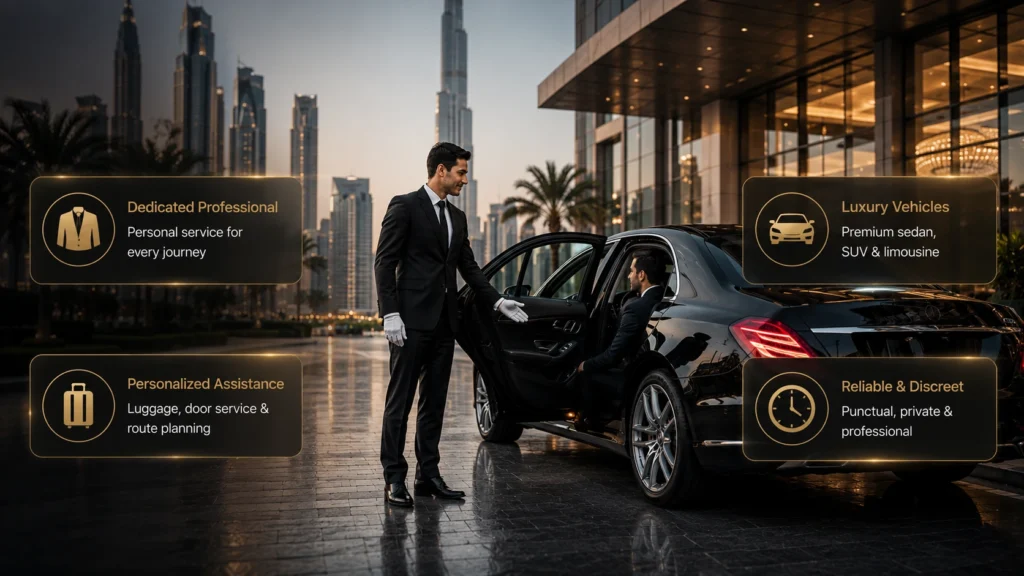
A few things define the word in current usage:
- Employment relationship: A chauffeur is paid to drive for a specific client, company, or family, rather than picking up random passengers.
- Vehicle type: Chauffeurs are almost always associated with premium or luxury vehicles such as a sedan, SUV, or limousine.
- Service standard: The role includes courtesy, presentation, punctuality, and discretion as core parts of the job, not optional extras.
- Scope of duties: Beyond driving, a chauffeur commonly assists with luggage, door opening, route planning, and coordinating pickup times around a client’s schedule.
This is very different from the word’s original meaning, which had nothing to do with luxury or professionalism at all.
Where Does the Word Chauffeur Come From?
The word chauffeur is French, and its story starts with steam, not cars. The term dates back to the 1890s, when it described a motorist, coming from the French chauffeur, literally meaning “stoker,” the person who operated a steam engine, from chauffer meaning “to heat.” The first chauffeurs were people employed to stoke a steam engine and keep it running, so the literal meaning of the word is simply “one that heats.”
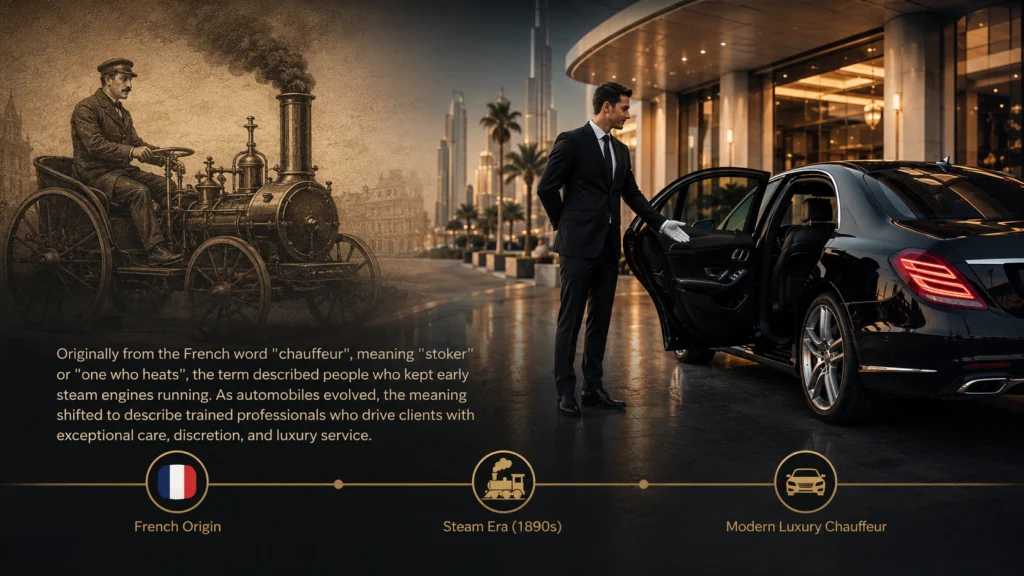
That origin explains why a word about heating engines ended up describing someone who drives a car. Early automobiles were noisy, smoky, and temperamental machines that reminded people of the steam engines used on trains, and the operators who kept those early cars running were jokingly given the same nickname as the men who fed coal into a furnace.
From Stoker to Driver: How the Meaning Changed
The title comes from the early days of automobiles, when they were still curious, rare, and, to many people, amusing to look at. Automobiles produced clouds of smoke and seemed to require constant work to keep them running, much like the steam engines used to pull trains, so the word used for the person who kept a steam engine’s fire going was applied to anyone driving an automobile. The narrower sense of “professional or paid driver of a private motor car” only developed a few years later, once cars stopped being a novelty and became something wealthy households actually hired staff to operate.
By the early twentieth century, the word had fully separated from its steam-engine roots and settled into the meaning we use today: a trained, paid driver of someone else’s car.
How to Pronounce Chauffeur
Because the word is French in origin, its pronunciation trips people up more often than its spelling does. If you are unsure about the correct way to say it, this guide on how to pronounce chauffeur explains the American, British, and French pronunciations clearly. Unlike most English words, the “ch” here is pronounced as a soft “sh” sound rather than the hard “ch” heard in words like “chair” or “chip.” This pattern shows up in a handful of other French loanwords that entered English around the same period, including “machine” and “chivalry,” which is why chauffeur can look deceptively like it should rhyme with “sculpture” when it actually rhymes more closely with “amateur.”
| Region | Common Pronunciation | Simplified Sound |
|---|---|---|
| American English | shoh-FUR | “sho-FUR” |
| British English | SHOH-fuh | “SHO-fer” |
| French (original) | sho-FUHR | closer to “show-FUHR” |
The stress usually falls on the second syllable in American English and on the first in British English, but both are considered correct.
Chauffeur vs Driver: What Is the Difference?
This is the question most people are actually trying to answer when they search for the meaning of the word. “Driver” and “chauffeur” are often used interchangeably in casual conversation, but they describe two different levels of service. If you are comparing professional private transport with regular driving services, understanding the difference between a chauffeur and a driver can help you choose the right option for business travel, airport transfers, or special events.
| Aspect | Driver | Chauffeur |
|---|---|---|
| Primary goal | Get passengers from one point to another | Deliver a complete, comfortable travel experience |
| Training | Basic license and road knowledge | Additional training in etiquette, routes, and passenger care |
| Vehicle standard | Any roadworthy vehicle | Typically, a premium sedan, SUV, or limousine |
| Presentation | No fixed dress code | Uniform or formal attire, groomed appearance |
| Extra duties | Rarely handles luggage or door service | Assists with luggage, opens doors, and manages timing |
| Typical use case | Taxis, ride-hailing apps, and general transport | Corporate travel, weddings, VIP events, airport transfers |
In short, every chauffeur can technically drive a car, but not every driver operates at the standard expected of a chauffeur. The distinction matters most when you’re choosing between a standard taxi and a proper private chauffeur service for something like an important business meeting or a special occasion.
Common Misconceptions About the Word Chauffeur
A few myths about the word tend to repeat themselves online, and clearing them up helps explain why the definition matters in the first place.

- “Chauffeur just means rich people’s driver.” Historically true to an extent, since only wealthy households could afford early automobiles and staff to operate them, but today the word simply describes the profession itself, used by corporate travel departments, hotels, wedding planners, and everyday travelers alike.
- “A chauffeur only drives, nothing else.” As covered above, the modern role includes route planning, luggage handling, scheduling, and a level of discretion that a standard driving job does not require.
- “Chauffeur and limousine driver mean the same thing.” A limousine driver is a chauffeur who specifically operates a limousine, but a chauffeur can just as easily drive a sedan, an SUV, or a van. The vehicle type is a detail, not the definition.
- “It’s an old-fashioned word nobody really uses anymore.” The opposite is true. Search interest in the term has stayed consistently high, and the role itself has expanded into corporate travel, VIP transport, airport pickups, and wedding logistics, all covered under the same original word.
What Does a Professional Chauffeur Actually Do?
A chauffeur’s responsibilities go well beyond sitting behind the wheel. On a typical booking, the role usually covers:
- Route planning: Checking traffic conditions in advance and choosing the fastest, most comfortable route rather than the most obvious one.
- Punctuality management: Arriving early, tracking flight or event schedules, and adjusting timing without being asked.
- Passenger assistance: Opening doors, handling luggage, and helping passengers in and out of the vehicle.
- Vehicle upkeep: Keeping the car spotless, fully fuelled and mechanically sound before every trip.
- Discretion and etiquette: Maintaining a quiet, professional presence, especially during business calls or private conversations.
- Local knowledge: Understanding the best pickup points, shortcuts, and venue access, particularly at busy locations like Dubai hotels and event venues.
This combination of skills is exactly why businesses, families, and event planners hire chauffeurs instead of simply calling a taxi.
Types of Chauffeur Services You’ll Find Today
The word chauffeur now covers a wide range of specific use cases, each with slightly different expectations. Understanding what a is chauffeur service helps explain how professional chauffeurs adapt their skills for corporate travel, weddings, VIP events, airport transfers, and other occasions.

- Corporate chauffeurs support executives and business travelers who need reliable, discreet transport between meetings, exactly the kind of service covered under a corporate chauffeur booking.
- Wedding chauffeurs focus on timing, presentation, and a flawless arrival, which is why couples typically book a dedicated wedding chauffeur rather than a standard taxi.
- Event and VIP chauffeurs handle high-profile arrivals where discretion and precise timing matter, the core of a VIP event chauffeur booking.
- Night-out chauffeurs give people a safe, unhurried way to enjoy an evening out, which is the whole idea behind a night-out chauffeur service.
- Shopping chauffeurs wait, carry bags, and manage multiple stops, a role built specifically for a shopping chauffeur booking.
- Airport chauffeurs track flight times and manage terminal pickups, forming the backbone of most airport transfer bookings.
Each of these is really the same core role, a professional, trained driver, applied to a different occasion.
Is Chauffeur Also a Verb?
Yes. Chauffeur works as both a noun and a verb in English. As a verb, “to chauffeur” someone means to drive them somewhere, usually with an implication of doing so as a favor or a job. A parent might say they “chauffeur the kids to school,” using the word loosely, while a company might say it “chauffeurs clients” to describe an actual professional service. The verb form entered English shortly after the noun, once “chauffeur” had already become associated with driving rather than heating engines.
Chauffeur vs Chauffeuse: The Gender Terms Explained
Chauffeur is grammatically masculine in its original French form. The feminine form, chauffeuse, refers to a woman who works as a professional driver. In modern English usage, “chauffeur” is now used as a gender-neutral term for the profession itself, and chauffeuse appears rarely, mostly in historical or formal writing. Professional chauffeur companies today, including fleets built around vehicles like a Mercedes S-Class or Rolls-Royce, typically use “chauffeur” for drivers of any gender.
Why the Distinction Still Matters Today
Understanding what chauffeur actually means is more than a vocabulary exercise. It sets a clear expectation of what you’re paying for. A taxi or ride-hailing driver gets you from one place to another at the lowest possible cost. A chauffeur is hired for the entire experience around that journey, the punctuality, the vehicle standard, the presentation, and the attention to a client’s specific needs. In a market like the UAE, where business travel, weddings and VIP events all rely heavily on private transport, that difference in meaning translates directly into a difference in service, comfort and reliability.
Frequently Asked Questions
Does chauffeur always mean a luxury driver?
Not strictly by definition, but in modern usage, the word is almost always tied to premium vehicles and a higher standard of service compared to a regular driver. A chauffeur can technically drive any vehicle, but the term carries an implied expectation of trained, professional-grade service, which is why it rarely gets used for a basic taxi or delivery driver.
Is a chauffeur the same as a personal driver?
Largely yes. “Personal chauffeur” and “personal driver” are used interchangeably to describe someone dedicated to driving one client, executive, or household on an ongoing basis, rather than picking up different passengers throughout the day. The main difference is that “personal driver” sometimes implies a more informal, family-employed role, while “chauffeur” more often signals a trained professional working through a service company.
Why is a French word used for a driving profession in English?
Because the earliest luxury automobiles and much of the early motoring culture came out of France in the 1890s, the terminology simply carried over into English along with the cars themselves. English has absorbed several French motoring and mechanical terms from this same period, including “garage” and “automobile,” largely because France led early automotive manufacturing and popularized the vocabulary that followed.
Do you need a special license to be a chauffeur?
Requirements vary by country, but most jurisdictions, including the UAE, require a separate professional or commercial driving permit beyond a standard license. In the UAE specifically, chauffeurs working for licensed transport companies must hold a valid commercial driving permit issued by the relevant roads authority, along with company-specific training in routes, safety protocols and customer service standards.
What is the female version of the word chauffeur?
Chauffeuse, though this term is rarely used today since chauffeur now applies to professionals of any gender. The word survives mostly in older texts, French-language contexts, and occasional formal writing, but virtually every modern chauffeur company, including fleets built around vehicles like a Mercedes S-Class or Rolls-Royce, simply uses “chauffeur” regardless of who is behind the wheel.
What’s the difference between a chauffeur and a limousine driver?
A limousine driver is technically a type of chauffeur, one who specifically operates a limousine rather than a sedan, SUV, or van. The word “chauffeur” describes the profession and service standard, while “limousine driver” describes a narrower job defined by the vehicle itself, so every limousine driver is a chauffeur, but not every chauffeur drives a limousine.
Can a chauffeur describe someone who drives family members without being paid?
Loosely, yes, though this is closer to the word’s use as a casual verb than its formal meaning as a job title. Someone might say a parent “chauffeurs” their children to school, borrowing the word to describe frequent, dedicated driving, even though no professional employment or payment is involved. As a noun describing an actual occupation, however, chauffeur specifically refers to paid, professional work.
Is chauffeur spelled or used differently in British and American English?
The spelling stays identical in both, but pronunciation and everyday usage differ slightly. British English tends to stress the first syllable and use the word more broadly in everyday conversation, while American English stresses the second syllable and often reserves the term specifically for professional, service-based driving rather than casual use.
Experience a Professional Chauffeur Service in the UAE
Now that the meaning is clear, the difference between hiring a driver and booking an actual chauffeur becomes easy to spot in practice, in the training, the presentation, and the level of care given to every trip. If you’re planning a transfer, a business trip, or a special event anywhere in the Emirates, you can see this standard for yourself with Chauffeur Emirates or get in touch directly to discuss what you need.
Sources: Merriam-Webster, “Chauffeur”; Etymonline, “Chauffeur”
