
Quick Answer
A driver is anyone who operates a vehicle to move passengers or goods from one place to another. A chauffeur is a trained professional who drives a premium vehicle on someone’s behalf and is also responsible for punctuality, presentation, discretion, and passenger care. Every chauffeur is technically a driver, but not every driver meets the training, licensing, and service standards expected of a chauffeur.
Introduction
People use “driver” and “chauffeur” as if they mean the same thing, and in casual conversation, that’s fine. But once money, timing, and reputation are involved, corporate travel, weddings, VIP arrivals, the gap between the two becomes very real. This guide breaks down exactly where that gap sits, so you know precisely what you’re paying for when you book a chauffeur service instead of calling a regular driver.
Chauffeur vs Driver at a Glance
Before getting into each factor individually, here’s how the two roles compare across the areas that actually matter when you’re deciding who to hire.
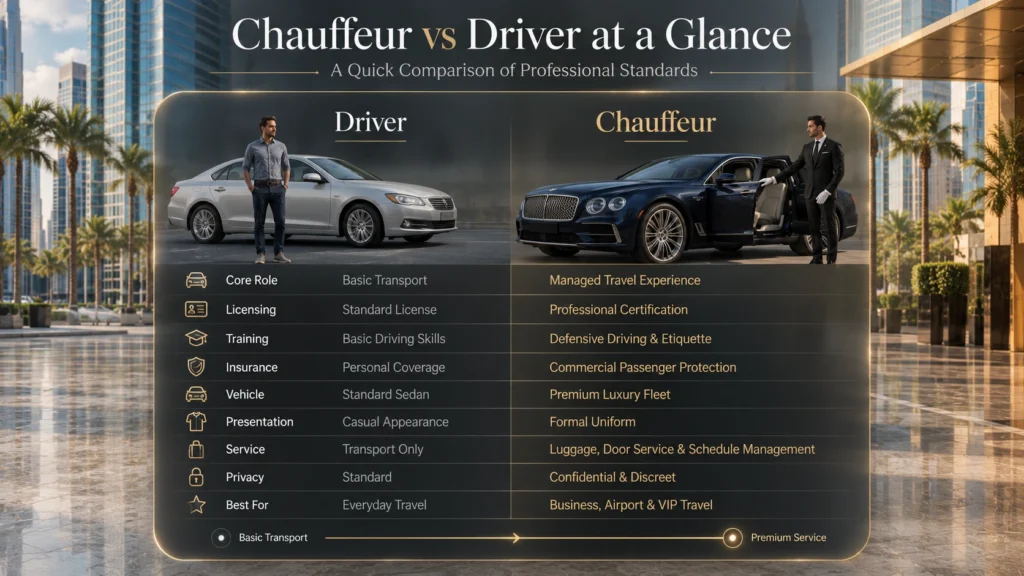
| Factor | Driver | Chauffeur |
|---|---|---|
| Core job | Move passengers from one point to another | Deliver a complete, managed travel experience |
| Licensing | Standard driving license | Standard license plus a professional or commercial endorsement |
| Formal training | Rarely required | Defensive driving, etiquette, and customer service training |
| Insurance | Personal vehicle insurance | Commercial liability insurance covering passengers |
| Vehicle | Any roadworthy car | Premium sedan, SUV, limousine, or van, well-maintained |
| Presentation | No fixed standard | Uniform or formal attire, professional grooming |
| Extra duties | Rarely included | Luggage handling, door service, schedule management |
| Discretion | Not typically part of the role | Confidentiality is expected as standard practice |
| Typical cost | Lower, metered, or flat-rate | Higher reflects training, insurance, and service level |
| Best suited for | Errands, short local trips, casual transport | Business travel, events, airport transfers, weddings |
This table gives you the overview. The sections below explain why each of these differences exists and what it actually means for the person sitting in the back seat. To understand the role in more detail, explore what a chauffeur means and how the profession has evolved beyond simply driving a vehicle.
Training and Licensing Requirements
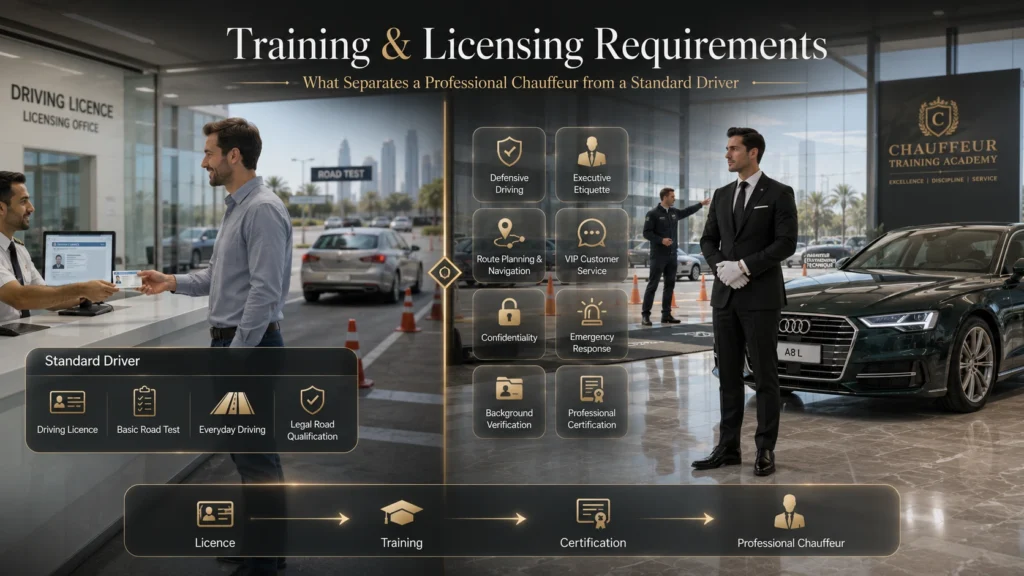
The clearest structural difference between a driver and a chauffeur sits in what each one is required to know before they’re allowed to work.
What Training Does a Chauffeur Complete?
Chauffeurs working for reputable companies typically go through structured training that covers far more than road skills. This usually includes defensive driving techniques for handling traffic, weather, and emergency situations safely, customer service standards covering everything from greeting a client to handling special requests, route familiarity so pickups and drop-offs run smoothly even during unexpected road closures, and etiquette training around discretion, appropriate conversation, and professional conduct. Many companies also require background checks and periodic retraining to keep standards consistent across their entire fleet of chauffeurs.
What License Does a Driver Need?
A standard driver generally only needs the same license required to legally operate a personal vehicle. There’s no formal requirement for customer service training, defensive driving certification, or ongoing skills assessment in most casual driving roles. This is exactly why a driver can be perfectly safe and competent behind the wheel while still lacking the structured, service-oriented training that defines the chauffeur role.
Insurance and Liability Coverage
Insurance is one of the most overlooked differences between the two roles, yet it matters enormously if something goes wrong during a trip.
A regular driver operating a personal vehicle is usually covered by standard personal auto insurance, which is designed around private use rather than paid passenger transport. A chauffeur, by contrast, works under commercial liability insurance specifically structured to cover paying passengers, higher-value vehicles and the increased risk that comes with professional transport work. This coverage is often a legal requirement for licensed chauffeur companies, not just a nice-to-have, and it’s part of why professional chauffeur services carry a higher operating cost than an individual driver.
Vehicle Standards and Presentation
A driver can technically use almost any roadworthy vehicle, and there’s rarely a fixed expectation around its condition beyond basic safety. A chauffeur service works differently. Vehicles are selected specifically for comfort, presentation, and reliability, commonly premium sedans, SUVs, or limousines drawn from a maintained fleet, and they’re kept to a consistent standard of cleanliness and mechanical condition before every single trip.
Presentation extends to the chauffeur as well. Uniforms, formal attire, or clearly defined dress codes are standard practice, whereas a general driver has no such expectation. For a client stepping out of the car at a business meeting or a wedding venue, this difference is immediately visible.
Service Scope: What Each Actually Does for You
The service scope is where the practical gap between the two roles becomes most obvious.
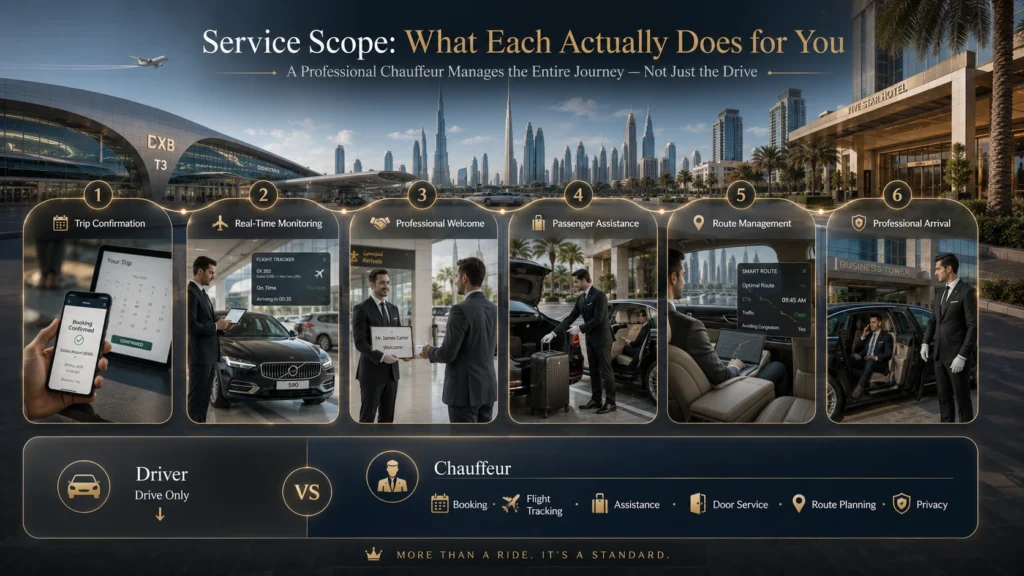
- A driver typically handles the drive itself and little else. Passengers are usually expected to manage their own luggage, timing, and route preferences.
- A chauffeur manages the entire journey around the client. This includes tracking flight or event timing, adjusting pickup schedules without being asked, handling luggage, opening doors, and maintaining a quiet, professional presence throughout the trip. These features are key parts of what is a chauffeur service and how it differs from standard transportation.
- Communication style also differs. Chauffeurs are trained to be responsive and proactive, updating clients about delays or route changes, while a standard driver may not offer the same level of proactive communication.
- Privacy and discretion are built into chauffeur service standards, particularly important for corporate travel and high-profile clients who need confidentiality during calls or private conversations.
Cost Comparison: Why Chauffeurs Cost More
Cost is usually the first question people ask once they understand the service differences, and the answer comes down to what’s actually included in the price.

| Cost Factor | Driver | Chauffeur |
|---|---|---|
| Base rate | Lower, often metered | Higher, usually flat or hourly rate |
| What’s included | Transport only | Transport, insurance, training, vehicle standard, service |
| Vehicle cost | Standard vehicle depreciation | Premium vehicle maintenance and presentation |
| Insurance overhead | Minimal | Significant, factored into pricing |
| Booking structure | Pay-per-trip, on demand | Hourly, daily, or event-based packages |
A chauffeur service costs more because the price reflects training, commercial insurance, vehicle standards, and a managed experience, not just fuel and time behind the wheel. For short, low-stakes trips, that premium may not be worth it. For anything tied to business outcomes, safety, or reputation, it usually is.
When Should You Book a Driver Instead of a Chauffeur?
A standard driver is a perfectly reasonable choice in several situations:
- Short, casual trips where cost matters more than presentation.
- Errands or personal tasks with no client, guest, or business impact.
- Situations where flexibility and low commitment matter more than a polished experience, closer to booking an hourly chauffeur for a short window than a full managed service.
- Budget-conscious travel where the difference in service level isn’t a priority.
There’s no need to overspend on a chauffeur for a quick trip to the supermarket. The value only shows up when the situation calls for more than basic transport.
When Is a Chauffeur Worth the Extra Cost?
A chauffeur becomes the clearly better choice once any of the following applies:
- You’re transporting a client, executive, or guest whose experience reflects on your business.
- Timing is critical, such as catching a flight or arriving for an important meeting.
- The occasion calls for a presentation, such as a wedding, VIP event, or corporate function.
- You need privacy for calls or confidential conversations during the trip.
- You want one point of contact who manages the entire journey without follow-up instructions.
In these situations, the extra cost buys reliability, presentation, and peace of mind, all things that are difficult to put a price on once something goes wrong with a lower-cost option.
Chauffeur vs Driver in the UAE: What to Expect

In the UAE, this distinction carries practical weight beyond convenience. Licensed chauffeur companies operating across Dubai and the wider Emirates are required to meet commercial insurance and permit standards set by local transport authorities, which is part of what separates a properly licensed airport transfer or VIP event booking from an informal private arrangement. Given how much of the region’s business, tourism, and event activity depends on reliable ground transport, that regulatory gap is one more reason the chauffeur standard tends to matter more here than in many other markets.
Frequently Asked Questions
Is every chauffeur automatically a good driver?
Not necessarily by driving skill alone, but chauffeurs are required to complete structured training that goes beyond basic road competence, including defensive driving and passenger safety practices. This training is specifically designed to reduce risk during paid passenger transport, which is a level of preparation most standard drivers never go through.
Can a driver become a chauffeur without extra training?
Technically, a driver could apply for chauffeur-level work, but reputable companies typically require additional licensing, background checks, and service training before allowing anyone to operate as a chauffeur. Simply holding a standard license is rarely enough to meet a company’s internal chauffeur standards.
Why is chauffeur insurance different from regular driver insurance?
Regular driver insurance is built around personal, non-commercial use of a vehicle, while chauffeur insurance covers paid passenger transport, higher-value vehicles and the additional liability that comes with operating as a professional service. This distinction is often a legal requirement, not just a business preference.
Is it worth hiring a chauffeur for a single airport pickup?
For a one-off airport pickup involving flight tracking, luggage handling and a tight schedule, many travelers find the reliability worth the cost, especially compared to the uncertainty of standard taxis or rideshare pickup points. For a short, low-stakes local trip, a regular driver or taxi is usually sufficient.
Do chauffeurs only work for luxury or corporate clients?
No. While chauffeur services are commonly associated with corporate and luxury travel, they’re also booked for weddings, family events, airport transfers, and even nights out where safety and convenience matter more than budget.
Does a chauffeur service always include a luxury vehicle?
Most chauffeur companies operate premium vehicles as standard, but the defining feature of the role is the training and service level, not the vehicle badge alone. A well-trained chauffeur in a well-maintained sedan still meets the professional standard, even without a flagship luxury model.
How can I tell if a company is providing a chauffeur or just a driver with a nicer car?
Ask directly about training programs, licensing, insurance coverage, and what’s included beyond the drive itself, such as luggage assistance or schedule flexibility. A genuine chauffeur service will have clear answers to all of these, while a rebranded driver service typically won’t.
Is the price difference between a driver and a chauffeur always significant?
It varies by market and provider, but chauffeur services are almost always priced higher than standard driving services because the cost structure includes training, commercial insurance, and a managed service experience. The size of the gap depends on the specific company and the type of trip being booked.
Choosing the Right Option for Your Next Trip
The right choice ultimately depends on what’s at stake during the journey itself. For low-pressure, budget-driven trips, a standard driver does the job perfectly well. For anything involving business outcomes, timing, presentation, or peace of mind, from a wedding to an important flight, a professional chauffeur is built specifically to remove that risk. If you’re planning a trip where the details matter, you can compare your options directly through Chauffeur Emirates or get in touch to discuss exactly what your journey needs.
Sources: Cambridge Dictionary, “Chauffeur”; U.S. Bureau of Labor Statistics, Occupational Outlook Handbook, “Taxi Drivers and Chauffeurs”
