
Quick Answer
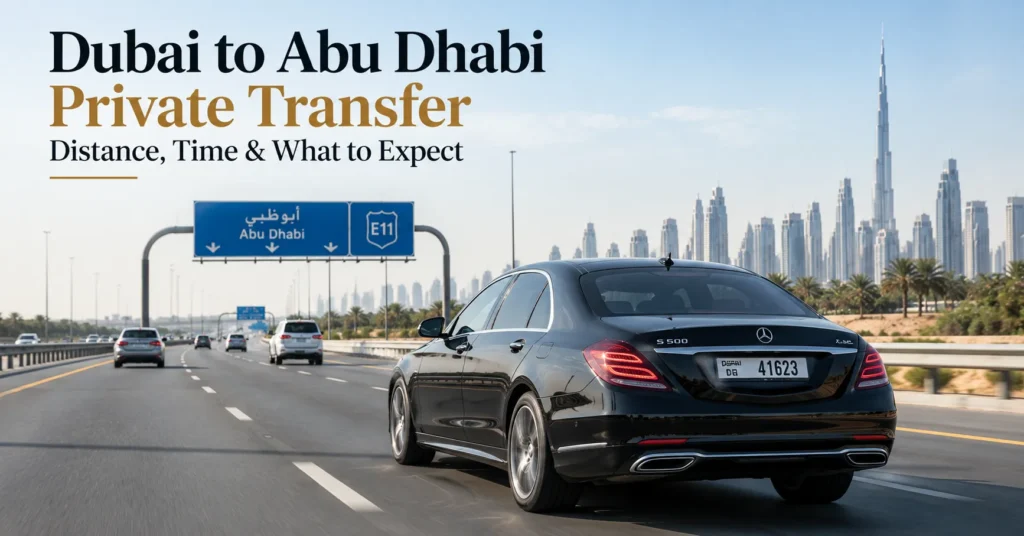
Dubai and Abu Dhabi are roughly 140 kilometers apart, with a private transfer typically taking between 1 and 2 hours depending on traffic and route. Most journeys use Sheikh Zayed Road (E11), the direct coastal highway, though Sheikh Mohammed Bin Zayed Road (E311) offers a quieter alternative during peak hours. Tolls apply on both sides through Dubai’s Salik and Abu Dhabi’s Darb systems, and a pre-booked private transfer removes the need to manage either directly.
Traveling between Dubai and Abu Dhabi, the UAE’s two largest cities, is a routine trip for business travelers, families and tourists alike, but the details, distance, timing, tolls and route choice matter more than they might first appear. It’s also one of the most common intercity journeys in the country, connecting the region’s main business and financial hub with the capital, home to many federal institutions and major embassies. This guide covers exactly what to expect from a Dubai to Abu Dhabi journey, and how a private intercity transfer compares to driving yourself.
How Far Is Abu Dhabi from Dubai?
The distance between Dubai and Abu Dhabi is approximately 140 kilometers via the most direct route, Sheikh Zayed Road (E11), with the alternative route, Sheikh Mohammed Bin Zayed Road (E311), running slightly longer at around 148 kilometers. The exact distance varies a little depending on your specific starting and ending points within each city, since both are large, sprawling urban areas rather than single fixed locations. A trip starting from Dubai Marina, for example, will differ slightly from one starting in Deira, even though both fall under the broader label of “Dubai to Abu Dhabi.”
Which Route Is Better: E11 or E311?
Both highways connect the two cities, but they offer noticeably different driving experiences.
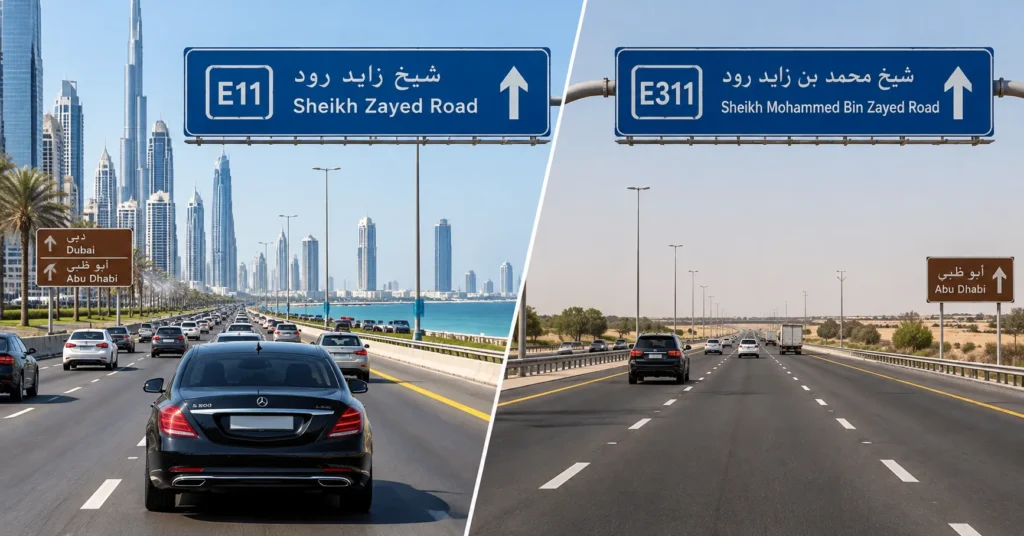
E11 (Sheikh Zayed Road)
Sheikh Zayed Road is the more direct, commonly used route, running close to the coastline and passing recognizable landmarks along the way. It’s well maintained, multi-lane, and generally the faster option outside of peak congestion, though it also tends to carry heavier traffic near both city centers during rush hour. Most first-time visitors default to this route simply because it’s the one most commonly suggested by navigation apps and the one most drivers are already familiar with.
E311 (Sheikh Mohammed Bin Zayed Road)
Running roughly parallel to the E11 but further inland, the E311 is the quieter alternative, popular with drivers looking to avoid central city traffic. It’s slightly longer in distance, and travel time is often similar to the E11 outside peak hours, but it becomes the more practical choice specifically when the E11 is congested or affected by an incident. Drivers starting from inland areas of either city, rather than closer to the coast, sometimes find the E311 a more natural starting point regardless of traffic conditions.
How Long Does the Drive Take?
Under normal conditions, the drive between Dubai and Abu Dhabi takes between 1 and 2 hours, with the exact time depending heavily on traffic, time of day and which route you take.
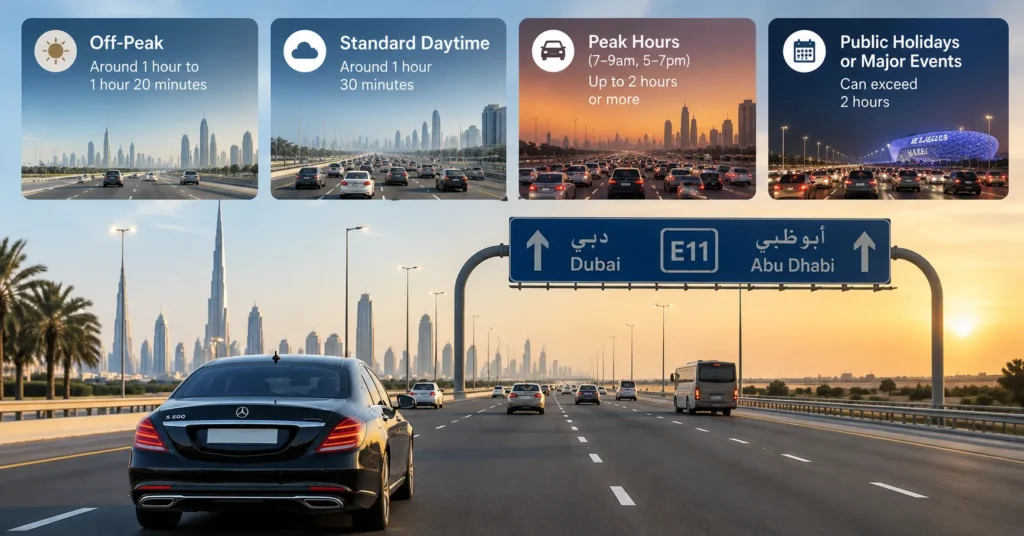
| Condition | Typical Travel Time |
|---|---|
| Off-peak, light traffic | Around 1 hour to 1 hour 20 minutes |
| Standard daytime traffic | Around 1 hour 30 minutes |
| Peak weekday hours (7–9am, 5–7pm) | Up to 2 hours or more |
| Public holidays or major events | Can exceed 2 hours |
Because the gap between best-case and worst-case timing is significant, booking transport with some buffer built in is worth doing for any trip tied to a flight, meeting or event schedule.
Toll Costs Between Dubai and Abu Dhabi
Both emirates operate their own electronic toll systems, and a trip between them typically involves passing through both. Dubai’s toll system, Salik, applies on sections of Sheikh Zayed Road within the emirate, while Abu Dhabi operates a separate system called Darb, which charges vehicles crossing specific gates into the capital during set hours. Darb currently applies charges during weekday morning and afternoon peak windows, with pricing based on individual crossings rather than a flat trip fee. The two systems operate independently of one another, with separate registration and account requirements, which can catch out visitors expecting a single unified toll system across the country. For a traveler without a UAE-registered toll account, this is one of the more easily overlooked costs of a self-driven trip, and it’s one of several factors covered in more detail in how much chauffeur driven car hire costs in Dubai.
Best Time to Travel Between Dubai and Abu Dhabi
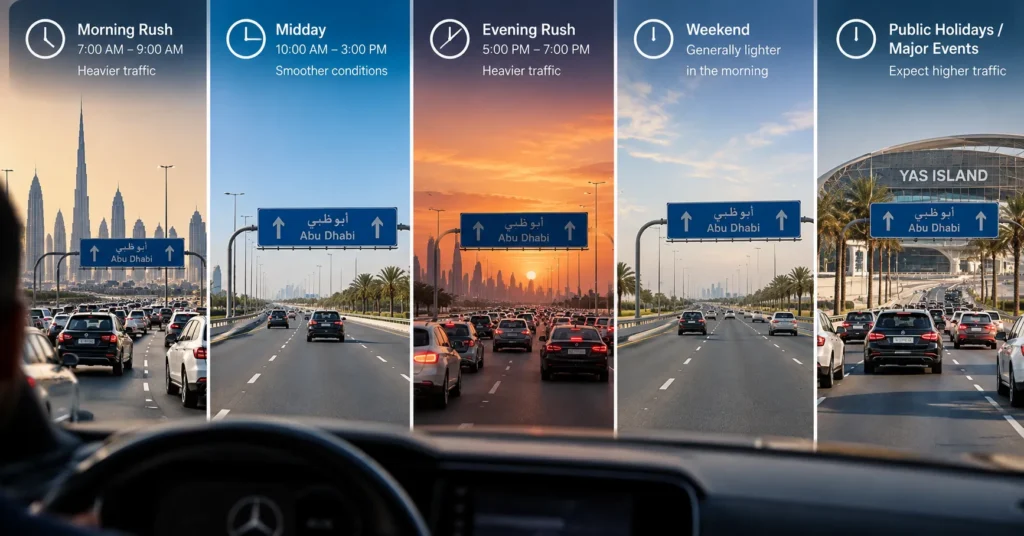
Traffic patterns follow a fairly predictable weekly rhythm. Weekday mornings between 7 and 9am see heavy traffic heading toward both city centers, while evenings between 5 and 7pm see the reverse as commuters return home. Midday travel, roughly between 10am and 3pm, tends to offer the smoothest conditions on a typical weekday. Weekends carry their own pattern, with earlier mornings generally quieter than late morning and early afternoon, when leisure travel between the cities picks up. Public holidays and major events in either city, whether a conference in Dubai or a large-scale event on Yas Island, can also push traffic well above typical levels regardless of the time of day, so it’s worth checking for any known events before finalizing travel plans around a tight schedule.
What to Expect During a Private Intercity Transfer
A pre-booked private transfer removes most of the planning burden involved in a self-driven trip. The chauffeur handles route selection in real time, adjusting between the E11 and E311 based on current traffic conditions rather than a fixed plan decided in advance. Toll payments across both Salik and Darb are handled as part of the service rather than requiring a separate account or top-up from the traveler, and the vehicle itself, drawn from a well-maintained fleet, is set up for comfort over what can be a fairly long stretch of highway driving, particularly valuable for business travelers who want to work, rest, or take calls during the journey.
Landmarks and Stops Along the Way
The E11 route in particular passes several recognizable points along the way, including views toward Yas Island as you approach Abu Dhabi, home to major VIP events throughout the year, the Jebel Ali area on the Dubai side, and long stretches of coastline and desert landscape between the two urban centers. While most private transfers run point to point without scheduled stops, many providers can accommodate a specific stop along the route on request, whether for a meeting, a meal break, or simply to break up a longer journey.
Why Book a Private Transfer Instead of Driving Yourself
For a one-off business trip or a family journey, a private transfer offers several practical advantages over self-driving. There’s no need to manage toll accounts across two separate systems, no risk of navigating unfamiliar routes during peak traffic, and no need to arrange parking or return transport at the other end. Fatigue is also a real factor on a drive of this length, particularly for visitors unfamiliar with UAE roads, speed limits or the location of speed cameras along the route. For corporate travel in particular, a private transfer also allows executives to remain productive throughout the journey rather than needing to focus entirely on driving for well over an hour each way.
What to Expect From Your Chauffeur on an Intercity Trip
On an intercity booking, the chauffeur typically confirms pickup timing in advance, tracks any relevant flight connections if the trip is tied to a Dubai Airport transfer on either end, and plans the route dynamically around real-time traffic conditions rather than committing to a single fixed path. This flexibility matters more on a longer intercity trip than on a short city journey, since conditions can shift meaningfully over the course of an hour or more between departure and arrival. For return trips or multi-stop itineraries within Abu Dhabi itself, some travelers extend the booking into an hourly chauffeur arrangement rather than booking the transfer alone, particularly when the visit involves more than a single meeting or destination.
Frequently Asked Questions
How much does a private transfer from Dubai to Abu Dhabi typically cost?
Pricing varies by vehicle class and provider, generally carrying a surcharge above standard within-city rates to account for the extra distance, tolls and return travel for the vehicle. A detailed breakdown of chauffeur pricing factors is covered earlier in this guide.
Is the E11 or E311 faster from Dubai to Abu Dhabi?
Under normal conditions, the E11 is typically slightly faster due to its more direct distance, but the E311 can become the quicker option specifically when the E11 is congested or affected by an incident.
Do I need to worry about tolls if I book a private chauffeur for this route?
No, toll costs across both Dubai’s Salik and Abu Dhabi’s Darb systems are typically included as part of a pre-booked private transfer, removing the need to manage separate accounts.
Can a private transfer be booked for a same-day return trip?
Yes, many providers offer same-day return bookings, either as two separate one-way transfers or a combined arrangement where the vehicle waits for a defined period between legs.
What’s the best time of day to travel between Dubai and Abu Dhabi to avoid traffic?
Midday, roughly between 10 am and 3 pm on weekdays, tends to offer the smoothest traffic conditions, while early mornings and early evenings on weekdays see the heaviest congestion.
Is a private transfer safer than driving yourself for this route?
Both options can be safe when driven responsibly, but a private transfer removes the fatigue factor of a long highway drive, particularly relevant for late-night arrivals or early-morning departures tied to flight schedules. It also removes the risk of an unfamiliar driver misjudging speed limits or missing an exit on an unfamiliar highway, both common issues for first-time visitors self-driving this route.
Does the route between Dubai and Abu Dhabi pass through any checkpoints or borders?
No, since both cities are within the United Arab Emirates, there are no international border checkpoints, though drivers should be aware of the separate toll systems operating on each side of the journey.
Can I request a stop along the way during a private intercity transfer?
Many providers can accommodate a specific stop on request, such as a meeting location or rest break, though it’s best to confirm this directly at the time of booking rather than assuming it’s automatically included.
Planning Your Dubai to Abu Dhabi Journey
Whether you’re traveling for business, a family visit, or simply exploring more of the UAE, understanding the distance, route options, and timing behind a Dubai to Abu Dhabi trip makes planning considerably easier. If you’re arranging an intercity transfer for an upcoming trip, you can book a fixed-price, chauffeur-driven journey with Chauffeur Emirates or get in touch to plan the route and timing that fits your schedule.
Sources: Integrated Transport Centre / Abu Dhabi Mobility, “Darb Fees”; Wikipedia, “Sheikh Zayed Road”
